Final drive
The ring-and-pinion ratio multiplying every forward gear. Higher numerical values generally raise RPM at a given road speed and increase wheel torque multiplication.
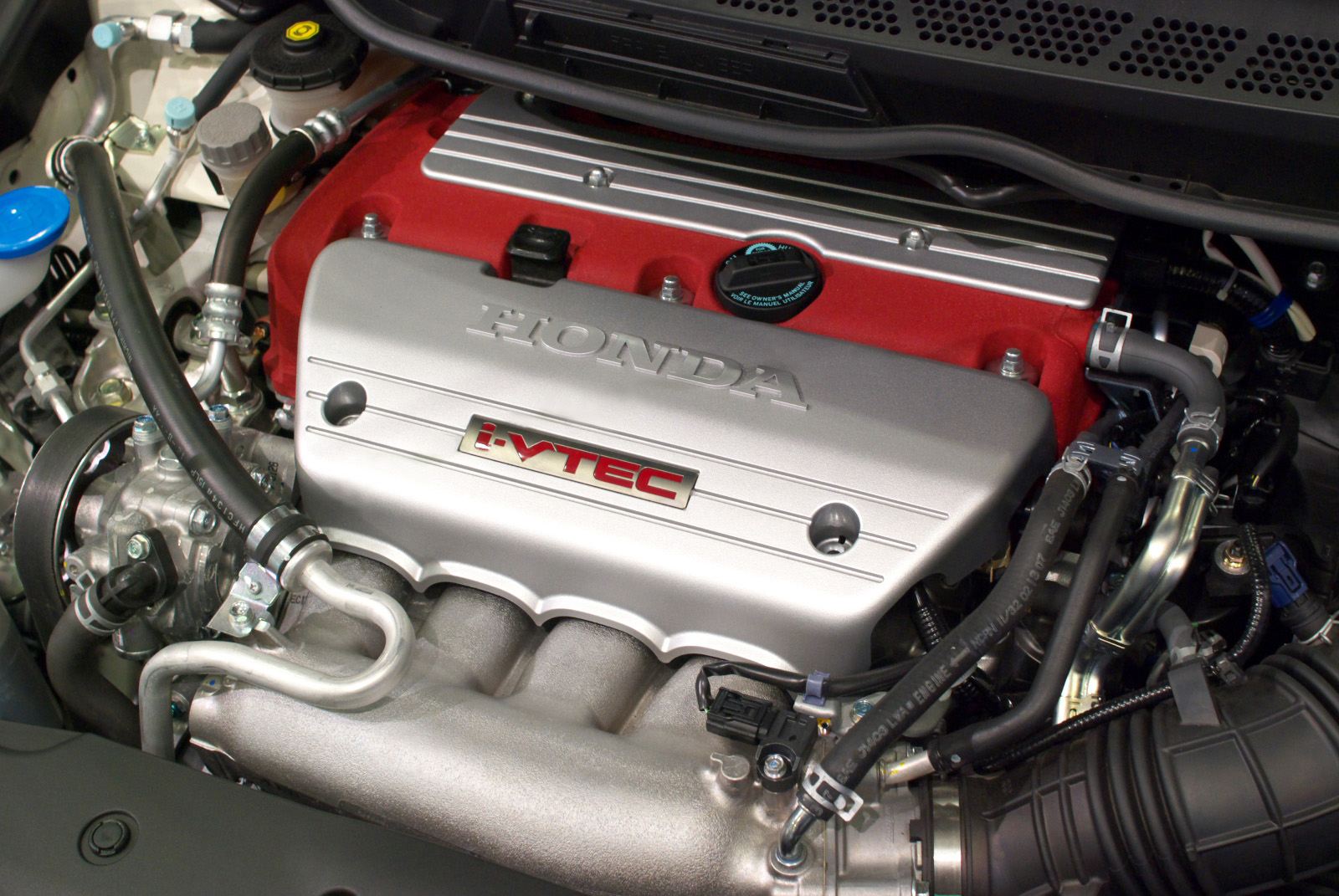
Engine codes. Transmission ratios. Chassis fitment. Wiring. Fuel. Cooling. ECU. Calculators. Checklists. Everything organized around the actual decisions that make a K-swap work.
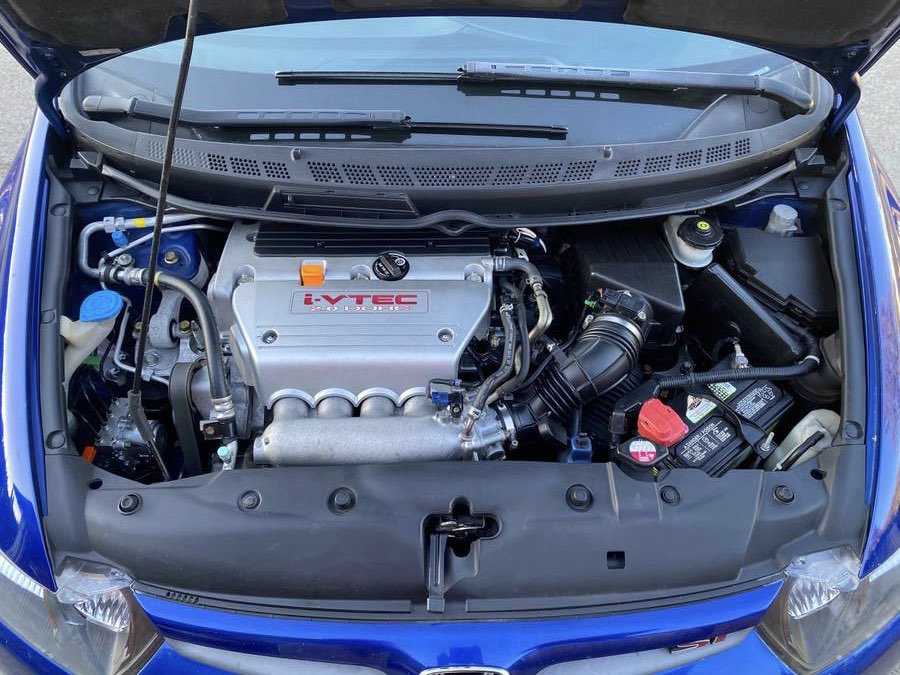
A real-world K-series engine bay reference. Image: Midship Runabout / Wikimedia Commons, CC BY-SA 4.0.
Start with the exact engine code, then build the supporting system around it.
Great for high-rpm naturally aspirated builds and lightweight chassis.
More displacement makes street gearing and midrange power especially attractive.
Direct-injected turbo K engines bring different ECU, fuel and integration requirements.
A good K-swap plan is engine + gearbox + chassis + electronics, not just an engine purchase. Because these are all lightweight 1990s-2000s shells (roughly 2,100–2,650 lbs), small weight differences change how much horsepower you actually need.
These lightweight-Honda K-swaps live and die by power-to-weight (pounds per horsepower — lower is faster). For reference, a modern Porsche 911 GT3 RS is roughly 5.8 lbs/hp.
| Chassis | Curb weight | ~220 whp | ~350 whp | ~750 whp |
|---|---|---|---|---|
| Civic EG Hatch | ~2,100 lbs | 9.5 lbs/hp | 6.0 lbs/hp | 2.8 lbs/hp |
| Civic EK Hatch | ~2,300 lbs | 10.4 lbs/hp | 6.5 lbs/hp | 3.0 lbs/hp |
| EM1 Coupe / DC2 Integra | ~2,600–2,650 lbs | 12.0 lbs/hp | 7.5 lbs/hp | 3.5 lbs/hp |
| Miata NA/NB (RWD) | ~2,150–2,350 lbs | 10.0 lbs/hp | 5.8 lbs/hp | 2.9 lbs/hp |
Figures are planning-reference estimates from community build data, not measured dyno/scale results for any specific car — actual weight varies with options, interior retained, fuel load and driver weight. Past roughly 400 whp, front-wheel-drive traction on street tires becomes the real limiting factor before power does; many builders budget for a CR-V/Element-based AWD conversion once they plan to cross 500–600 whp.
The stock EK subframe pushes the K-series engine farther forward than an EG or DC2 subframe does — tighter radiator/AC clearance, worse axle angles and less header room. Swapping in an EG or DC2 front subframe (with matching lower control arms, steering rack and compliance bushings) is one of the most common upgrades paired with an EK K-swap, and it is not a pure bolt-in — budget the donor hardware and a fresh alignment.
Available in manual (smaller rack tube, narrower D-bracket spacing, ~19.0:1 ratio) or power steering versions. Slightly lighter in manual form. Many base EG models lack front sway-bar mounts.
Almost always power steering (wider rack tube/D-bracket spacing, ~16.1:1 ratio — noticeably quicker) and includes proper sway-bar mounts/tabs — the preferred donor if you want a front anti-roll bar.
Use an EKK2-style (or equivalent dual-height) kit built specifically for an EG/DC2 subframe on an EK chassis — not the stock-EK-subframe version of the mounts.
EK bolts, lower control arms and compliance bushings generally do not fit the EG/DC2 subframe — source the matching donor hardware rather than reusing EK parts, transfer the correct steering rack and D-brackets for manual vs. power, and budget for a professional four-wheel alignment afterward since the suspension geometry has changed.
If a builder gets a single master pin connection wrong, the swap will crank without ever firing. This section covers split-harness logic, the '02–'04 PRB pinout reference, the K20/K24 crank sensor trap, harness sourcing options and ECU choices.
Routes directly from the K-series fuel injectors, ignition coil packs and block sensors back to the ECU. Handles injector pulse triggers, coil control, VTEC solenoid, and cam/crank sync signals.
Bridges the ECU to the host chassis: gauge cluster, ignition/chassis switches, immobilizer, oil pressure light and the fuel pump main relay.
Continuity-check every master pin before first crank. Most "cranks but won't start" cases trace back to a ground, a swapped pin, or an unaddressed immobilizer signal.
The K20 harness plug physically clips onto a K24 crank sensor, but the internal pin architecture is different. Plugged in unmodified, the ECU won't read RPM and will throw a sync error, refusing spark and fuel. Re-pin the K20 harness connector to match the K24 sensor before assuming a bad part.
| Pin cavity | K20 harness wire | Target for K24 sensor | Function |
|---|
Built for a specific engine + chassis combination. Fastest path, least troubleshooting, but least flexible if your donor engine/ECU combo is non-standard.
Re-uses the donor engine harness with pins moved to a chassis-specific connector. Cheaper but time-intensive and depends entirely on correct pin mapping.
Built from a pinout sheet for standalone ECUs or heavily modified electronics. Most flexible, most labor, and the least forgiving of documentation mistakes.
Works within the factory ECU. Straightforward for factory-supported engine/ECU combinations; less flexible for non-stock sensors or heavily modified fueling.
Similar factory-based tuning approach, commonly used on later drive-by-wire K-series ECUs.
Full aftermarket ECUs for engines outside factory ECU support, forced induction, or non-stock sensor packages — at the cost of a fully custom wiring and calibration effort.
Mixing K20 and K24 parts is one of the most common swap strategies, but a handful of wiring differences cause the majority of no-starts, RPM faults and random cut-outs. This is what actually matters when the engine, harness and ECU don't all come from the same code.
| Engine | Common ECU | Throttle | Notes |
|---|
Most "cranks but won't start" problems on K20/K24 mixes come from three places: crank sensor pinout, the immobilizer, or a missing ground/power feed. Check those three before replacing parts.
Injectors and the fuel pressure regulator (FPR) are chosen as a matched pair for your power goal and fuel type — not bought separately at whatever size is on sale. Undersize either one and you'll run out of fuel under boost; oversize it on pump gas and idle quality, mileage and low-RPM control all suffer.
Poorly flow-matched budget injectors cause erratic idling and can run one cylinder lean while another runs rich. Premium and exclusive-tier injectors are matched to tight tolerances and ship with full dead-time (latency) data for your ECU.
A return-style bypass regulator keeps rail pressure rock-solid under load. Pairing a big aftermarket pump with an undersized regulator causes fuel pressure creep — pressure climbing uncontrollably at idle because the regulator can't bypass enough volume.
Oversized injectors on a mild pump-gas street car struggle to meter tiny pulses of fuel at idle — stumbling, a rich idle and poor mileage. Buy one tier of headroom above your actual power target, not the number you might hit someday.
Set-of-4 pricing, from budget-conscious street builds up through exclusive, high-end racing tiers.
Needed any time you convert to a return-style system or run a high-flow aftermarket pump.
Dead time is the delay between the ECU commanding an injector open and it actually flowing fuel — critical for clean idle and part-throttle fueling, and it must be entered correctly into your ECU (KPro, KTuner, Haltech, Hondata, etc.). Lower battery voltage raises dead time; higher fuel pressure raises it slightly too. Always use the datasheet from your specific injectors over a generic value.
| Injector | Approx. dead time | Notes |
|---|---|---|
| Stock K20/K24 (310–350cc) | ~0.8–1.1 ms at 14V | OEM baseline reference |
| RDX 410cc-style | ~0.9–1.3 ms at 14V | Commonly used values — varies by source |
| Bosch EV14-based (DW, FIC, etc.) | Manufacturer datasheet | Usually shipped with full dead-time tables |
| Injector Dynamics (ID1050x/ID1300x) | Manufacturer datasheet | Excellent published data by voltage |
The right fuel plumbing changes completely as the power target climbs — from a factory-style return system all the way to a full tank-to-rail braided build.
Use the exact gearbox code whenever possible. Year and market changes matter.
| Gearbox | Donor / years | 1st | 2nd | 3rd | 4th | 5th | 6th | Final | LSD | Use |
|---|
Click a row to load its gear ladder.
Launch feel, wheelspin and how quickly the engine climbs through the early gears.
Often the most important gears for street pulls, autocross and road-course exits.
Cruising RPM, highway comfort and top-speed potential.
Changes every forward gear. Compare it before assuming two “6-speeds” behave the same.
General sanity-check ranges for common K-series fasteners and service items. These are typical values seen across the K-series family, not a substitute for the factory service manual for your exact engine code.
Filter by Street or Track, prioritized Must / Recommended / Nice-to-have. Your checklist saves automatically in this browser.
Short reference cards for the decisions that usually cause the most rework.
Common post-swap symptoms, likely causes and a sensible order to check them in. Tap a symptom to expand it.
Reference photos from Wikimedia Commons. Licensing and attribution are shown with each image.
Public domain image by Hatsukari715 / Wikimedia Commons.

i-VTEC head reference; Joe Flores / Wikimedia Commons, CC BY-SA 3.0.

Matt / Wikimedia Commons, CC BY-SA 2.0.

Tennen-Gas / Wikimedia Commons. Public domain / GFDL history.

Mr.choppers / Wikimedia Commons, CC BY-SA 3.0.

Nimda01 / Wikimedia Commons, CC BY-SA 4.0.

Iamjosemom / Wikimedia Commons, CC BY 4.0.

Mr.choppers / Wikimedia Commons, CC BY-SA 3.0.
The fastest way to avoid mismatched parts is to compare the whole powertrain, not isolated components.
Prioritize midrange torque, comfortable cruise RPM, OEM-like drivability and a sensible final drive.
Keep the engine in the powerband with a closer spread and aggressive final drive.
Choose gearing, clutch, differential, axles and cooling around the actual torque target—not just horsepower.
Code, head, oiling, sensors, ECU.
Ratios, final drive, differential, code.
Mounts, axles, hubs, clearance.
Fuel, cooling, exhaust, wiring, tune.
A gearbox that looks “better” on paper can be worse for your build if its final drive, clutch interface, shifter arrangement, axle spline, differential or speed-sensor strategy does not match the chassis.
Green = straightforward, reference-compatible bellhousing family. Yellow = possible, but needs specific parts, an adapter or extra verification. Red = not recommended as a direct pairing. Tap any cell for what's actually involved.
Select any square in the matrix above to see exactly what a given engine-family / gearbox pairing requires.
Quick definitions for the terms you will see while planning a build.
The ring-and-pinion ratio multiplying every forward gear. Higher numerical values generally raise RPM at a given road speed and increase wheel torque multiplication.
The ratio for one individual gear. A smaller numerical ratio is taller; a larger numerical ratio is shorter.
Limited-slip differential. Helps manage torque distribution between driven wheels when traction differs.
Variable Timing Control. Honda terminology for cam timing control used across many K-series variants.
Honda’s variable valve timing/lift system family. Exact hardware and behavior depend on engine generation and code.
Anti-theft system that can prevent an ECU/engine combination from starting unless the correct key/security strategy is satisfied.
Controller Area Network. Modern Honda systems may use CAN messages for cluster, ECU, ABS and other module communication.
Drive-by-wire electronic throttle. The pedal and throttle body communicate electronically rather than through a mechanical cable.
A short connecting shaft used on some chassis/transmission combinations to link the transmission output to one of the axles when lengths or offsets don't match directly.
A conservative starting tune loaded before first start, meant to get the engine running safely — not a finished, optimized calibration.
A relay that supplies power to the ECU and fuel system. A failed or miswired main relay is a common no-start cause after a swap.
The bearing surface between the connecting rod and crankshaft journal. Bearing condition and clearances matter when evaluating a used core, especially a high-mileage or unknown-history one.
On-board diagnostics generations used across Honda ECUs and model years. The generation affects connector pinout, diagnostic tools and which ECUs are electrically/programmatically compatible.
Community shorthand distinguishing K24-based blocks (“big block”) from K20-based blocks (“small block”) by physical case size, independent of the specific head or tune.
A packaged set of mounts, brackets and sometimes axles/wiring adapters designed for a specific engine-to-chassis combination. Kit scope varies a lot between vendors — confirm exactly what's included.
Whenever a forum post says “all K-series parts are interchangeable,” stop and identify the exact engine code, transmission code, year, market and chassis. That is where most compatibility mistakes start.
Planning tools for gearing, tire size and budget.
Approximation using tire diameter; real-world speed varies with tire growth, slip and calibration.
Realistic parts-cost ranges by tier, from junkyard-budget to full RWD conversion.
Planning reference only — actual cost depends heavily on core condition, region, whether you DIY labor, and exact parts chosen.
Six connected tools sharing one calculation engine: Easy Mode, Pro geometry/BMEP math, the Frankenstein Builder, Turbo Match, the Build Planner (parts list + cost + build health), and a shared Dyno Database for predicted-vs-actual comparisons.
This tool runs in its own isolated frame with its own calculation engine — open it in a new tab for a full-screen view.
Pick the major pieces and generate a starter list.